What we believe
Most tools for bipolar disorder are built to record what you feel. We built one to help you understand it.
Recording what you feel was never the hard part. We wanted a place to watch your own mind with a little more patience and a little less judgment — not a record of everything you got wrong, but a clearer view of the life you are actually living.
You already watch yourself closely
If you live with bipolar disorder, you already spend a great deal of energy watching yourself. Was that a good mood, or a warning? Am I only tired, or is something turning?
A single day rarely answers those questions. What matters is the shape a life takes over weeks and months — how far the swings reach, how long they last, how quickly the ground moves underfoot. That shape is what a person needs to see, and it is exactly what a day of scores cannot show.
Logging is not understanding
Most trackers assume the problem is missing data — that if you record enough, insight will follow. But people living with bipolar disorder are rarely short on feeling. They are short on perspective, and on the calm it takes to find it.
A complete record of a hard month is not the same as understanding it. The data grows; the person disappears into it.
Knowing how you felt is not the same as understanding how you are.
Every choice inside POLARITY comes from a belief about what this condition asks for. A belief is only worth stating if you can point to where it changed what you made.
You are not one number
Almost every tracker asks you to press the day into a single figure, low to high. For many minds, one line is enough.
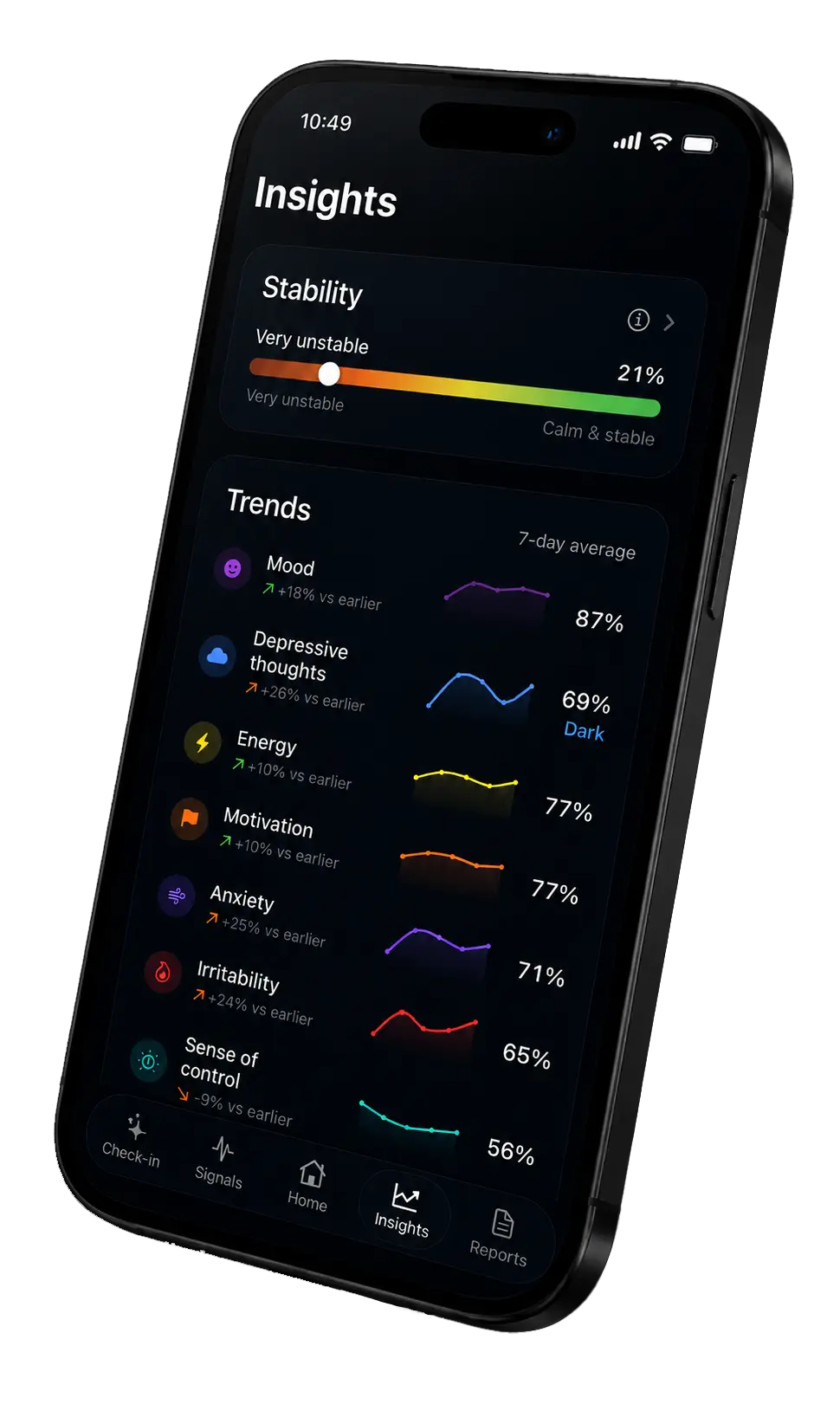
Bipolar disorder does not live on one line. You can be flattened and wired at the same time. Empty and racing. Exhausted and unable to stop. Averaged into one number, the very thing you needed to notice disappears.
Independent depression and elevation, never a single mood score.
We separate depression and elevation because bipolar disorder cannot be understood on a single emotional scale — the two can climb at once, and one number would bury the pattern you most need to see.
The goal was never to feel higher
When you live between poles, happiness is not the target — and a very good day can be the opening line of a very hard week. A high is not always a reward; sometimes it is the part that has to be watched.
What helps is not more height. It is more ground — enough steadiness to still recognize yourself tomorrow.
Stability over highs.
We treat a steady stretch as the outcome worth noticing, not your brightest peak, because the aim is rarely to feel more — it is to swing less, and to trust the ground under your feet.
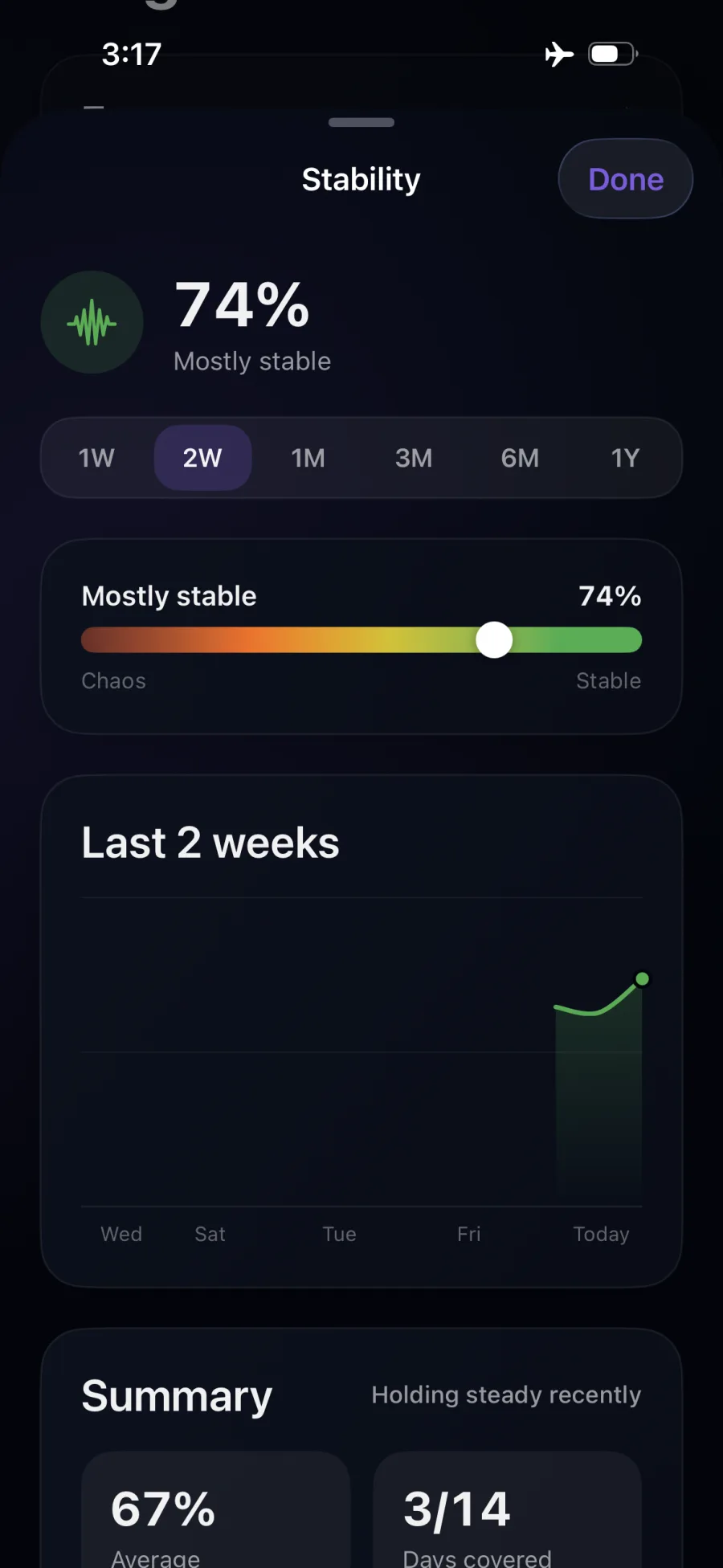
Stability is not the absence of feeling. It is the room to feel something without being carried off by it.
Some weeks, this is the app you barely open
Recovery does not move in a straight line. Some weeks you check in every morning. Some weeks getting out of bed is the whole of the accomplishment — and those are often the days that mattered most.
The last thing anyone needs then is a broken streak, counting the mornings they could not manage to show up.
Today is always enough.
POLARITY can recognize consistency, but a missed day never erases what you already built.
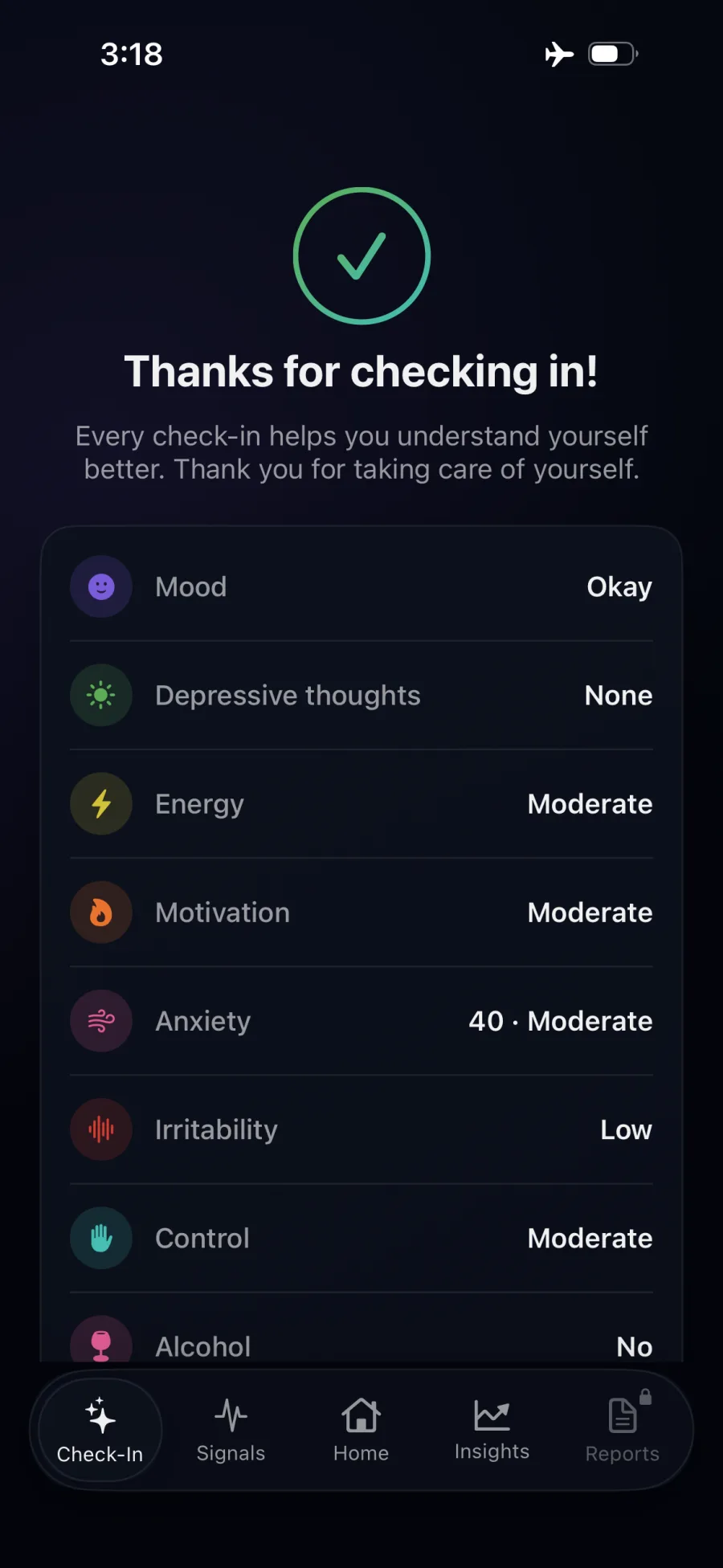
A missed day is not a broken streak. It is a day you were living.
Progress without punishment.
POLARITY includes milestones and Moondust, but they are designed around participation rather than perfection. Moondust is earned through check-ins and never sold; milestones mark what you have already done. Neither should make a missed day feel like failure.
You do not have to earn tomorrow by getting today right.
Calm is not the absence of a feature. Calm is the feature
Software competes for your attention by default. Notifications that tug, badges, colors that pull you back — most of it exists to bring you in again. For a tool meant to help you steady yourself, that instinct is exactly backwards.
So POLARITY asks for little, interrupts rarely, and is content to be closed. Technology should support a life from the edge of it, not demand the center of it.
Privacy is a decision, not a promise
What you write about your own mind is among the most private things you will ever keep. Most apps send it away by default and ask you to trust that they will be careful with it.
We think some thoughts belong only to you, and trust is a fragile place to keep them. So your reflections stay on your device by design, not by permission. There is nowhere central for them to leak from, because there is no center.
It is a quieter promise, and a much harder one to break.
Local-first.
Your reflections stay on your device, because some thoughts belong only to you.
On-device intelligence.
Any reflection is drawn from your own words, on your device, and sent nowhere else.
Privacy by design.
Privacy is built into how the app works, not a setting you must find and switch on.
It can help you look. It cannot tell you what you see
When POLARITY notices something — a rhythm, a shift, a pattern in your own words — it offers it as a question, not a conclusion. At most, it helps you bring a sharper question to the people who can answer it.
It is not your clinician, and it will never pretend to be. Its whole task is to help you see a little more clearly, then leave the meaning to you and to the people trained to help.
Honest uncertainty.
We say a pattern might be worth watching, never that we know what it means, because the line between a tool that helps you notice and a clinician who can treat is one we mean to keep clear — for your safety, not our comfort.
The measure of this app is not how much you record in it, but how much better you come to know yourself.
The principles
- Independent depression and elevation instead of a single mood score. Two separate axes, because one line cannot hold what bipolar disorder actually does.
- Stability over highs. The aim is not to feel more, but to swing less — and to trust the ground under you.
- Today is always enough. One honest entry completes the day. No streak to break, no debt to yesterday.
- Progress without punishment. Nothing to win, nothing lost by staying away. Made for honesty, not performance.
- Local-first. Your entries live on your device, not on our servers. No center for them to leak from.
- On-device intelligence. Any reflection is drawn from your own words, where they already are, and goes no further.
- Privacy by design. Settled in how the app is built, not in a setting you must find and defend.
- Honest uncertainty. A pattern offered as a question, never a verdict, and never in place of a clinician.
What we are actually trying to do
POLARITY will not cure bipolar disorder, or manage it for you, or promise that software can make it lighter than it is. No honest tool would, and dishonesty is a poor foundation for something you are meant to trust on hard days.
We are trying to build something smaller and more useful: a place to see the shape of your own experience clearly — steady enough to lean on, honest enough to believe, and undemanding enough to still be there on the day you almost didn't open it.
If, in time, it helps a person understand themselves a little better and judge themselves a little less, it will have done the thing it was built to do.
POLARITY is a tool for self-observation and wellbeing. It does not diagnose or treat bipolar disorder, and it is not a substitute for professional care. Read more.